BLUEBOOK OF PIANOS
PIANO
CONSTRUCTION AND SCALE DESIGN
THE
STRINGS
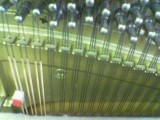
PIANO STRINGS
Every musical effect in a piano must originate in the strings. The soundboard, no matter how perfect, can only amplify the sound produced by the strings. Pianos have from 215 to 230 steel strings graduated in length and thickness to produce the 88 notes of a piano's scale design. The shortest string is about 2", the longest string may be 84" or longer.
- The bass strings should be pure copper wound, not plated.
- Examine the spacing of the strings in relation to other strings, spaced evenly without touching another string.
- Depressing a key slowly, check damper alignment.
- At the same time, check as hammer strikes the strings.
- Check to see if hammers strike all of the strings of all notes.
- Inspect the strings for even spacing (not touching another string) and proper alignment with the dampers.
- Listen to the piano - Is the tonal output powerful enough, at least impressive enough that you should expect from a "classic" piano, but capable, nevertheless, of filling a room no larger than 15 square feet or of a volume not more than say, 2500 cubic feet ?
- Is the tonal output reasonably mellow? (Very bright indicates hardened hammers from age or dry climatic conditions).
- Is the tone even and with a fair singing quality ?
- Is the action satisfactory, that is, does it give a fairly elastic response to your touch ?
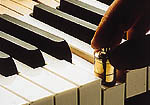
The proper weight for key depression is between 2 and three ounces in general. Simply take a scale such as weight watchers, or the postage scale at the post office. Get a few weights (fishing tackle ok) and find a small weight that weighs around 2 1/2 to 3 ounces.. place that weight on any piano keyboard where the fingers play and the key should depress. This is an accurate, but simple way to test for touch, the average touch is around 2½ ounces. Get a weight watchers scale and weigh out several coins to make up 2½ ounces. Place them where the fingers would be.



PIANO AGE | ARCHIVES | APPRAISALS | PIANO TYPES | BLUEBOOK VALUE | SELL A PIANO
Copyright © 2015 Bluebook of Pianos All Rights Reserved - Copyright laws exist to protect our intellectual property. They make it illegal to reproduce someone else's expression of ideas or information without permission. At one time, a work was only protected by copyright if it included a copyright trademark (the © symbol). According to laws established in 1989, however, works are now copyright protected with or without the inclusion of this symbol. Anyone who reproduces copyrighted material improperly can be prosecuted in a court of law. It does not matter if the form or content of the original has been altered -- as long as any material can be shown to be substantially similar to the original, it may be considered a violation of the Copyright Act.